Tuesday, November 15, 2011

The FILM IN A BOX Project...

I recently had the opportunity to interview Peace Anyiam-Osigwe, the founder of Africa Movie Academy Award. I was thrilled to hear her talk about her passion for the movie industry in Africa. Especially, when she mentioned "The Film in a Box" Project, aimed at empowering the younger generation with new knowledge and professional training to help them excel in the movie industry.

Here is a short excerpt from the interview:


Aside the award, what other role do you play in boosting the movie industry in Africa?
Peace Anyiam-Osigwe:
Various projects that I work on are linked to support our endeavors for the youth. Each is linked either directly or indirectly towards empowerment of youth and industry building and women. The FILM IN A BOX Project is one that I am very passionate about - advocating for women in making their voices heard.

Tell us a bit more about yourself (your background, career path, aspirations etc.)
Peace Anyiam-Osigwe: I graduated with a Degree in Law and Political Science from Oxford Brookes University. I am also a presenter of talk shows, writer and producer. One of my trademark projects is the training of young filmmakers called Film in the Box, which is run by the Africa Film Academy. Some of my film productions include such notable titles as Blind Date, Fear of the Unknown, Sons of Thunder, Messenger of Doom, Preacher Daughter, and Laviva. My television programmes include Ada, Gra Women, and Young Stars.

In addition I was also the National Vice- President of the Association of Movie Producers (AMP) and Director of finance for the Filmmakers’ Co-Operative of Nigeria. My contribution to the Africa Film industry is reflected in a documentary “Peace Mission” directed by Dorothee Wenner, and premiered at the prestigious Toronto film festival in 2009.

I served on numerous juries like the Berlin film festival, short film jury and Cine Del Sur. This is coupled with being a speaker at several panels on African cinema, from Fespaco - to the Rio film festival. I am also a Ted Fellow and was selected for the Pan African film festival/africa channel Visionary award for contribution in promoting African culture through the internationally recognized (AMAA) in 2010, and coupled with another internationally acclaimed award- the African Visionary Award by UNESCO in Cannes.

Wow! You have achieved and are achieving a lot! What is your advice to young upcoming movie producers, directors, actors/actresses and other stakeholders in the movie industry to ensure growth in the industry?
Peace Anyiam-Osigwe:
Exceed your best and continually reinvent yourself by empowering your talent with new skills. Educate and share knowledge and embrace change for it is the only constant thing that is guaranteed. You have to do new things to get new results.


READ THE FULL INTERVIEW ON CP-AFRICA.COM! CLICK HERE

Sunday, November 13, 2011

Review: State of the African Youth Report 2011


Africa's future hinges on the extent to which nations deliberately and adequately invest in youth development and empowerment.

Africa can be classified as a very young population. Data from the United Nations Population Division show that in 2010, there were 364 million Africans aged 15-34 years and 209million aged 15-24 years. The latter, account for 20.2% of the total African population.

The African Union Commission says they are committed to promoting youth development and empowerment in Africa. In partnership with the United Nations Population Fund, they commissioned the status of the African Youth. According to Prof. Jean-Pierre Ezin, Commissioner, Human Resource Science and Technology (AUC), the report titled "State of African Youth 2011," gives critical analysis of the continent's actions and inform further discourse at all levels- from policies to strategies, to implement programmes related to youth empowerment and development.
The report provides a baseline- an evidence based account of the state of young people in Africa today. it traces the challenges, presents accomplishments by AU member states, partners and young people themselves, and offers a roadmap on the way forward in supporting the youth development agenda.
Starting this week, I will be reviewing and sharing key points published in this report. Don't miss this series on CP-Africa.com!

Thursday, November 10, 2011

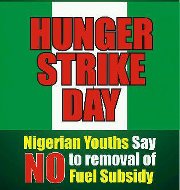
Nigerian Youth 11-11-11 Hunger Strike to Protest Removal of Fuel Subsidy


VENUE: UNITY FOUNTAIN, NEAR TRANSCORP HILTON
TIME: 9AM TILL 4PM


Read Wale Ajani's Press Statement. Click here

Wednesday, November 09, 2011

Thank you Mr Patrick....


Last week, I was almost murmuring about why Nigerians love public holidays so much. Actually, I did enjoy my holiday. Well, until I ran out of Internet access and realised my work will be left unattended to if I did not renew my subscription immediately. The office of the Internet provider also observed the public holiday so there was no way out. Or so I thought.

A friend suggested to drive through Starcomms office to see if the retail distributors were available. But then, she came up with a better idea- to call one of them and find out where he was.

Mr Patrick, one of the distributors confirmed what we already knew- all the retail shops were closed. If you reside in Abuja you’ll understand how shutdown the city looked during this holiday; even though it was suppose to be a festive one. The fear of Boko Haram sent "everyone" indoor.

To cut the long story short, Mr Patrick offered to recharge my line. He has never met me yet he was willing to take the risk. He said that he would renew my Internet subscription and collect the money after the holiday.  Within a few minutes, my Internet access was restored.

I met Mr. Patrick the following day to make my payment. Out of curiosity, I asked if he did that often. He showed me a notebook with numbers of people who subscribe through him. Just a phone call and bam! he play his role while they play theirs.

Trust and honesty is the watchword.

I began to imagine what our society would look like if we had more of Mr Patrick and the people who do business with him in Nigeria. More honest Nigerians. More transparent Nigerians. More people of integrity. More selfless people. More people who are willing to think good of others irrespective of their tribe or family background.

The socio-economic situation is not looking good in Nigeria.  But you know, a change in attitude and action will change everything.

We blame Goodluck Jonathan for things wrong in Nigeria. The meat seller who cheats others in the market blames the government. The religious leaders who brainwash their followers and stir up religious crisis blame the government. The teachers and others active in public service that collect bribe also have the guts to blame the government. The uncles and fathers who abuse the girls and women in their care blame the government.The employer who exploit the employees in his organization blame the government.

I am not a saint. I also blame the government when things really suck.

But I realize the day we stop the blame game and start acting responsibly is the day Nigeria will start working.

In a nutshell, if we all can take out the log in our eyes before trying to take out the plank in our government leader's eyes, NIGERIA will be fine.  Our government leaders misbehave because they know some of us are easily swayed by empty promises. But that too has to change.

In case your path crosses with that of a Mr Patrick in future- tell him thank you, again. For trusting and showing that we can start by trusting each other to change Nigeria.

My encounter with Mr Patrick reminded me that Nigeria is not a big geographical location far from our sphere. Nigeria is you and I. Our attitude to one another have a rippling effect on the way the government leaders perceive us. Be the change you want to see in Nigeria- this is not a cliche.

Tuesday, November 08, 2011

IBK @spaceshipboi: Interview with D'LICIOUS


Get to know more about IBK on an up close and personal level! Watch his interview with  D'LICIOUS:
Do  you know IBK now has a blog? Check it out>>> http://www.ibkspaceshipboi.blogspot.com
ALSO READ Exclusive INTERVIEW and special feature on IBK @spaceshipboi, winner of Don Jazzy's Enigma Competition

Saturday, November 05, 2011

"The eMJOY Channel" MUSIC VIDEO and YGM-VTECH Mixtape Release


It's here finally: Video and Mixtape both now available from emerging hip-hop artist eMJOY


ARTIST BIO: 
eMJOY, birth name MAYOWA ADEBAJO, is a gospel artist, songwriter and performer, primarily in the HipHop genre. He is currently a university student of Media in Toronto, Canada, and  hails from Ogun state, Nigeria. 
 
Beginnings: At about age 10 Mayowa was already performing for fun to a small group of family but his first concert stage performance happened when high school peers soon noticed his rap talent and featured him in an end of  year variety show concert. He was 15 years at the time and he left the school repeating the chorus of his rendition for a while. 
 
The Career: eMJOY has been performing across Toronto, Canada including during Jesus Family Church events, RCCG youth events, Haiti Community gigs, Worship 4 Life Concerts, Emua Fashion Show (2010), York University NSA (Nigerian Students Association) Gala 2011, and it goes on. 
 
He says, “My vision in the music industry is to make beautiful, classic-lasting music for the world that should draw us all nearer to the mind-blowing Love of God even through the good news of Jesus Christ. I also seek to inspire my birth country Nigeria -and Africa- at large to her true potentials.” 
 
In order to reach eMJOY for bookings, management info, media interviews and/or features you may contact him via emjoychannel@live.ca 
Facebook.com/theemjoychannel; Twitter: @eMJOYtruly

Friday, November 04, 2011

Interview: Kenya is a fertile ground for women participation in politics, says Felogene Anumo


Felogene Anumo is a female activist based in Kenya, who served as a panelist during the just concluded 7th UNESCO Youth Forum in Paris. Drawing from her experience working as a youth activist and her work at *Women in Law and Development in Africa, Felogene shares her views on the different barriers militating against women participation in politics, especially in Kenya. She encourages youth and young women to focus on how to create job opportunities for themselves instead of seeking job employment. Read the full interview below:


Please tell us more about what you do:
My name is Felongene Anumo. I’m from Nairobi Kenya. I’m a program officer for Women In Law and Development in Africa. I’m basically a young gender activist in my country. We try to involve young women in political processes and processes we feel that their voices need to be heard.
How would you describe the current trend of women participation in Kenyan politics?
The current situation on gender issues I believe is a very fertile ground for young women and women in general to get involved.  In August 2010, we passed a new constitution, which has set a very good ground for young women to participate because we have very good provisions. One of such include that for every post elected or nominated, it has to be 50-50. For example, if a chair is a man, the vice-chair is a woman and vice versa. We need qualified women to be going for those posts because our constitution, which is the supreme law, has already provided a fertile ground for them.
So the challenge for us as young women and women who know exactly what the society needs is to go out for the posts and show that women can indeed provide good leadership for any nation. 
Are women responding to these opportunities?
Women are responding. But you must realize that we come from a history where cultural and patriarchal system has been the order of the day. For example, the best performances in the past years since independence in 1963 is the current sitting government, which is only 10% of women. With the new constitution coming in, they need 33% minimum of any gender. For women, we need at least 23% more. I believe in as much as we are responding, the citizens also need to know that women will come out, but they need to be voted for because the positions are elective.
Why do you think some African cultures are slow in embracing the concept of women leadership and gender equality?
In my country, two months ago a company called Infotrack did a survey. And the question they asked was “Would you vote a woman in” A majority said yes. But the question is, when you think about a woman, do you think about my mother? Because I’m sure if you are asked, would you vote your mother in, of course you will say yes. But then when they come to the poll they don’t vote women in. so I think it is either a cultural issue or perhaps we have not been the best example.  It is not really because of out of choice but out of circumstance.  
As women, our challenge is health and education. One thing I am sure about is that if women get into these posts, they will speak about the issues that affect the communities because naturally we are nurturers and caregivers. We will take care of the communities in as well as we take care of our families. It is important for the mentality of Africans to change in this regard.
Is your work only focused on women participation in political position?
We advocate for women participation especially in political participation where decisions are made in the country.
Especially, but not limited to?
Yes. In terms of the jurisdiction of what I do. But I believe whatever small thing you are doing as a young woman, whether it is in the community, whether it is in the hospital, whether it is in a family, you need to be responsible. “She who is trusted with little will be trusted with much” whatever little you have been given to do as a leader, set that good example. People will judge us based on our track record as women leaders. And then it is easier for us to advocate for these bigger positions.
So many programs are focused on empowering women and girls; do you think this will in anyway have rippling effect of disenfranchising the men?
I don’t think so because this (the programs to empower women and girls) is what we call affirmative action. An affirmative action is based on correcting injustices that have happened historically. Women have always been marginalized. So there has to be a measure to see how we can involve them. Affirmative action have to work with a timeline- it is an action, not a vision.  When we have affirmative action, we have equal playing field and then we can equally compete fairly. But it will not have a backlash. But if it does, then affirmative action will move to empowering the boys as well. So really, it is not an issue of one overtaking the other but an issue of being just and fair to one another.
How can young women better position themselves to overcome employment barriers that exist in our world today?
Firstly, I believe that young people are so creative that they cannot confine themselves to employment barriers. Of course employment can only accommodate only a certain number of people. In my country there are thousands and thousands of graduates, not all of them can be employed. The question we should be asking is how can young people provide employment opportunities for each other.  But just to answer your question on how young women can overcome employment barriers, first be informed. Don’t take short cut. When you get an opportunity to sit on a table with your employer, be informed. Know about the company. Know about yourself- what you are able to give and what you are not able to give. And that gives you a good platform to be employed. Be consistent. It is a tough world. There are many good graduates. The population is getting higher. You have to be competitive and consistent. And never give up. Never give up. 

About WiLDAF
*Women in Law and Development in Africa (WiLDAF) Kenya is a registered Pan-African, Non-Partisan, Non-Governmental Organization that works to promote and strengthen strategies which link law and development to promote a culture for the exercise of and respect for women’s human rights in Africa. WiLDAF works to promote women’s human and legal rights and the active participation of women in development at all levels. Our ideas and vision for existence are anchored on the values of gender equity and equality, social justice and fair representation. 

You can follow her on Twitter: @felogene